The 2026 farm financing map: what operating loans, equipment, FSA, and farmland loans actually cost
What operating capital, equipment financing, irrigation loans, FSA programs, and farmland purchase loans actually cost producers in 2026 — and when specialist farm lenders beat the bank.
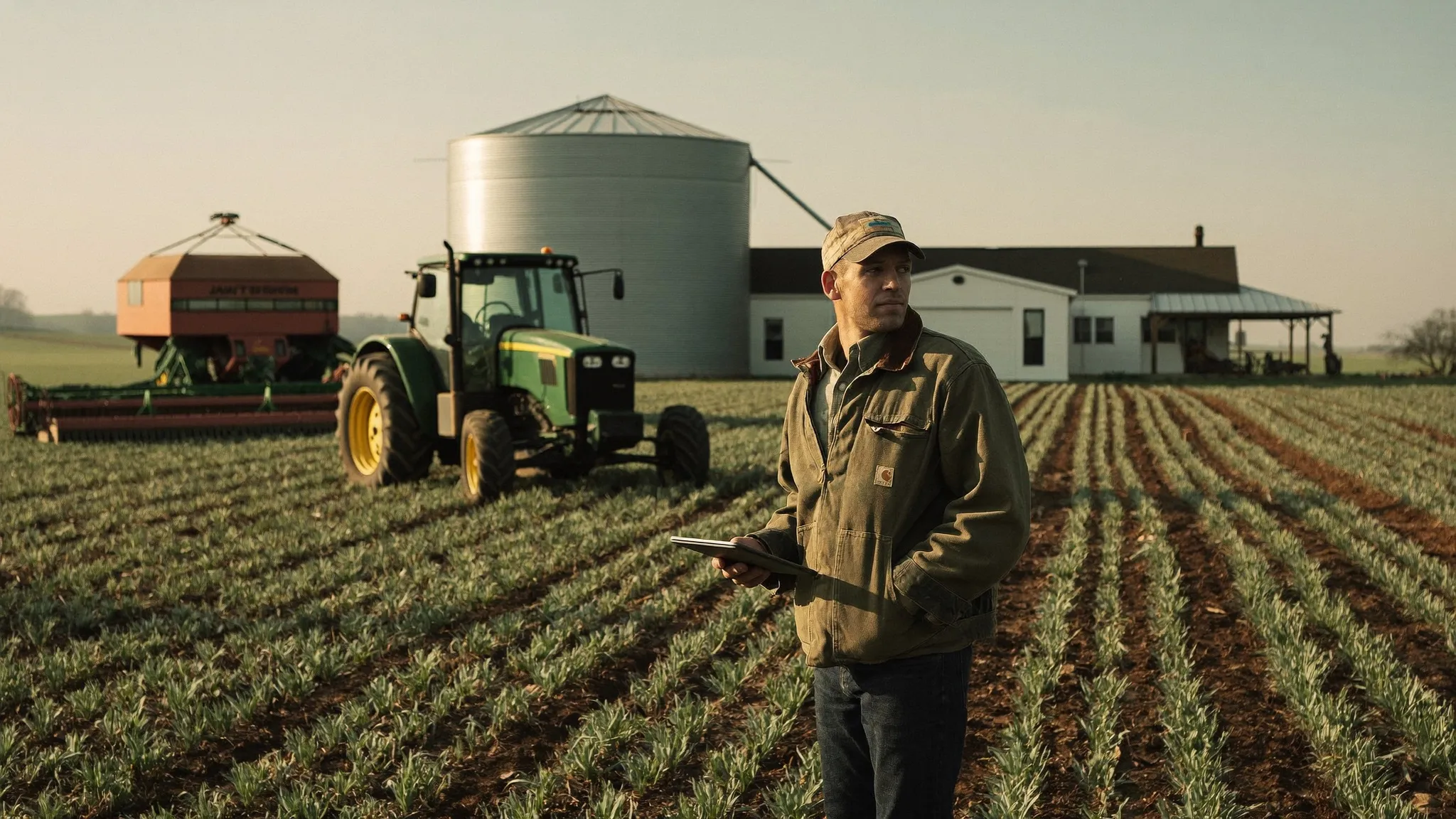
There’s a particular squeeze that defines row-crop and livestock operations heading into the back half of 2026. Input costs — fertilizer, seed, chemicals, and diesel — have settled meaningfully above their 2022 levels and show no sign of reverting. Cash corn is hovering in the $4.20 to $4.40 range, soybeans in the low $10s, and the crush and basis structures that producers relied on for marketing flexibility two years ago have compressed. Cash-rent renewals are coming in tighter conversations than they used to. And the working capital line that was sized in 2023 against a different set of input costs is not, for many operations, sized correctly for what the 2026 crop year actually demands.
None of that is catastrophic by itself. What it adds up to is a financing menu producers need to think about more deliberately than they did during the 2022–2023 boom, and a new class of farm-specific lenders that are outperforming the generic small-business credit defaults on the speed-sensitive work.
This is a map of what the financing options actually look like for producers in 2026 — what each one costs, when each fits, and where Farm Service Agency programs, specialist farm lenders, and the local ag bank each win.
Why generic small-business lending misreads a farm
Most small-business credit is built around a service or retail baseline: monthly recurring revenue, modest equipment needs, a balance sheet that grows in a predictable line. Farms don’t underwrite that way. Revenue arrives in two or three large pulses per year — harvest, government program payments, livestock sale dates — not in monthly deposits. Equipment isn’t a side cost; on a 2,000-acre row-crop operation, the line tractors, combine, and grain cart can be the largest single category on the balance sheet. Land is either the entire asset base or the entire collateral story, and neither reads cleanly to a generic underwriter. Weather and basis cycles can compress an entire year’s marketing window into six weeks.
Generic underwriting models flatten that into “irregular cash flow” and price it accordingly — or, more often, just decline the application. That’s why a category of lenders that underwrite farm cash flow has emerged: products that read crop insurance proceeds as a revenue signal, that underwrite against equipment value the way an equipment finance company would, and that price storage and marketing flexibility into the structure rather than penalizing it. The mechanics are the same as generic lending. The assumptions are different.
The five financing types producers actually use in 2026
Most operations use a combination of five products. Each fits a different cash-flow problem.
Operating lines
The annual operating line is what funds the gap between paying for inputs in March and getting paid for the crop in October or November. Trade-fluent operating lenders are running roughly in the 8.5 to 12% range as of mid-2026 for established operations with three years of clean books, and somewhat higher for newer operators or those without strong working-capital cushions. Specialist operating line financing built for row-crop and livestock operations tends to size against expected gross revenue using crop insurance APH yields and current futures, which is a closer match to how a farm actually generates cash than the trailing twelve months of bank statements a generic small-business lender will ask for. The decision speed advantage is real — approvals in two to three weeks against the four to eight weeks a community bank will commonly run.
Equipment financing
Tractors, combines, planters, grain handling, livestock equipment, trucks — anything titled or with a serial number — finance at terms ranging from 36 to 84 months with rates in roughly the 6.5 to 11% range for established operators in mid-2026. Equipment lenders underwrite the asset, which is why approvals are typically faster than working capital. The 2026 tax overlay matters here: Section 179 lets producers expense up to $2,560,000 of qualifying equipment in the year placed in service, and the One Big Beautiful Bill Act reinstated 100% bonus depreciation for assets placed in service after January 19, 2025. For an operator buying a $400,000 combine in 2026, that’s a meaningful first-year tax shield against a strong income year — and a real reason to time the equipment decision to the tax year rather than only to the equipment market.
Irrigation systems
Center pivots, drip systems, pumps, and the trenching and electrical that goes with them have moved up significantly in installed cost over the last three years — a quarter-mile pivot that ran $85,000 installed in 2022 is closer to $115,000 to $130,000 in 2026 depending on geography and water source. The product fit is medium-term equipment financing with seasonal payment structures that align repayment to the irrigation season’s revenue. Specialist irrigation equipment financing programs typically offer 5 to 10-year terms with the option to skip payments outside the growing season — a structure that generic equipment lenders don’t write and that materially changes the cash-flow impact of the investment.
Farmland purchase loans
The land side of the balance sheet runs on a different clock and a different product. Farmland values in the Corn Belt have held remarkably firm — Iowa was averaging $13,200 per acre in late 2025 and hasn’t moved much through the first half of 2026 — and acquisition financing has matured into a deeper market than it was a decade ago. Farmland purchase loans from specialist farm credit sources commonly run on 20 to 30-year amortizations with rates landing in roughly the 6.5 to 8% range as of mid-2026 for strong borrowers, often with 5 or 7-year rate resets rather than the fully fixed structure of a residential mortgage. The down-payment expectation is typically 25 to 35% on contiguous expansion ground, higher on standalone parcels without an existing operating tie-in.
FSA Direct programs
The Farm Service Agency remains the structurally cheapest capital for the producers who qualify. As of mid-2026 — after the January 1 cap adjustments — the Direct Farm Ownership Loan cap is $700,000 with terms up to 40 years; the Direct Operating Loan cap is $450,000; and the Microloan program (which uses the same underlying rates as the corresponding Direct programs with substantially lighter documentation) caps at $60,000. Interest rates are reset monthly by USDA and have been running in the high 4% to mid-5% range over the past year — meaningfully below what any commercial lender will write.
Two caveats define when FSA fits. First, the qualification bar prioritizes producers who cannot get credit elsewhere at reasonable rates, which is what the program is designed to do — operators with strong banking relationships and clean conventional access often will be redirected by their county office to a guaranteed loan through their commercial lender rather than a direct loan. Second, timing. FSA underwriting is thorough, county-office capacity varies, and even the streamlined Microloan path runs longer than the same-week decision a specialist lender will make. For beginning farmers, expansion plays without elsewhere-credit access, and any acquisition where the rate spread justifies the calendar, FSA is the right first conversation. For an operator who needs an operating line approved before planting begins in three weeks, it usually is not.
Before you sign anything: run the actual payment
The discipline that separates producers who handle 2026 well from those who get squeezed by it isn’t sophisticated. Before signing any financing instrument — operating line, equipment note, irrigation system, or land loan — run the actual proposed payment through a monthly payment calculator for farm loans at the exact rate, term, and down payment the lender is offering. Then redo the math at two stress scenarios: corn at $3.80 and beans at $9.50, and a rate one full point higher than what’s currently on the term sheet. The land loan that pencils cleanly at $4.30 corn and 7% money looks different at $3.80 corn and 8%. The combine payment that fits comfortably against a strong 2025 income year looks different against a softer 2026.
That isn’t about pessimism. It’s about sizing the financing against a realistic floor rather than against the year you’d want to have. The producers who carry too much debt into a soft year are almost always the ones who underwrote against the year they were having when they signed.
When FSA wins and when specialists win
Three situations where FSA is unambiguously the right answer:
Beginning farmer expansion. If the operator meets the FSA definition of beginning farmer — has not operated a farm for more than 10 years — the Direct Farm Ownership and Direct Operating programs are pricing and term advantages that no commercial lender will match. The longer FSA timeline is rarely the binding constraint on a multi-year expansion plan.
Operators without elsewhere-credit. This is exactly what the Direct programs exist for. Producers without a strong commercial banking relationship, or carrying recent credit events that close conventional doors, should be in their county FSA office before they’re anywhere else.
Land acquisitions where the rate spread justifies the calendar. A 4.5% direct ownership loan versus a 7.5% commercial farmland loan is roughly a 30% reduction in monthly payment on the same balance. On a 30-year amortization, that’s the difference between an acquisition that cash-flows and one that doesn’t.
Three situations where specialist farm lenders win:
Speed-sensitive operating capital. If the operating line needs to be funded before planting begins, FSA timelines often don’t work. Specialist farm lenders pricing in the 8.5 to 12% range and approving in two to three weeks are the fit.
Equipment that needs to be on the farm by a specific date. Equipment lenders are typically the fastest path to a confirmed payment schedule against a specific machine.
Operations above the FSA caps. When the financing need exceeds $450,000 operating or $700,000 ownership, FSA Direct is structurally out and the conversation moves to guaranteed loans through commercial lenders, specialist farm credit, or commercial farm banks.
Reasonable operators use both. The mistake is assuming the conventional product is the right answer for every need — when in 2026, it’s often the right answer for some of them and not others.
Before you apply: the operator checklist
Before approaching any farm lender, have the following ready. The difference between a two-week approval and a six-week approval is almost always how clean the package looks on day one.
- Three years of Schedule F or farm tax returns — and a current-year P&L if you’re more than six months into the year.
- Crop insurance records — APH yields by crop and county, current-year coverage levels, and most recent claim history.
- Equipment schedule — current equipment list with year, make, model, hours, and rough current market value, plus existing financing balances.
- Three months of operating account statements — all operating accounts, not selected ones.
- Land schedule — owned acres, cash-rent acres, share-rent arrangements, and any near-term lease expirations.
- Insurance documentation — current property, liability, and where applicable, crop insurance certificates with no lapses in the file.
That’s it. Anything more sophisticated comes from the underwriter, not the applicant.
The bottom line
The producers funding 2026 well aren’t doing anything exotic. They’ve stopped treating “the bank” as the default and started matching the product to the need — FSA for the long-horizon, structurally cheap capital they qualify for, specialist farm lenders for the speed-sensitive operating and equipment work, commercial banks for the relationship business they’re already inside of. Before any of it, they’re running the real numbers on the actual purchase at a realistic price floor, not against the year they had when the term sheet showed up. A combine, an irrigation system, or a quarter-section of expansion ground looks different on paper than it does in a monthly payment — and most signing regret is just a calculator that didn’t get opened.