Cash rent versus farmland purchase math in 2026: when buying the parcel finally pencils
Cash-rent renewals are coming in tighter conversations in 2026, and the math on whether to bid up the rent or buy the parcel outright is back in front of more operators. The actual numbers, run honestly.
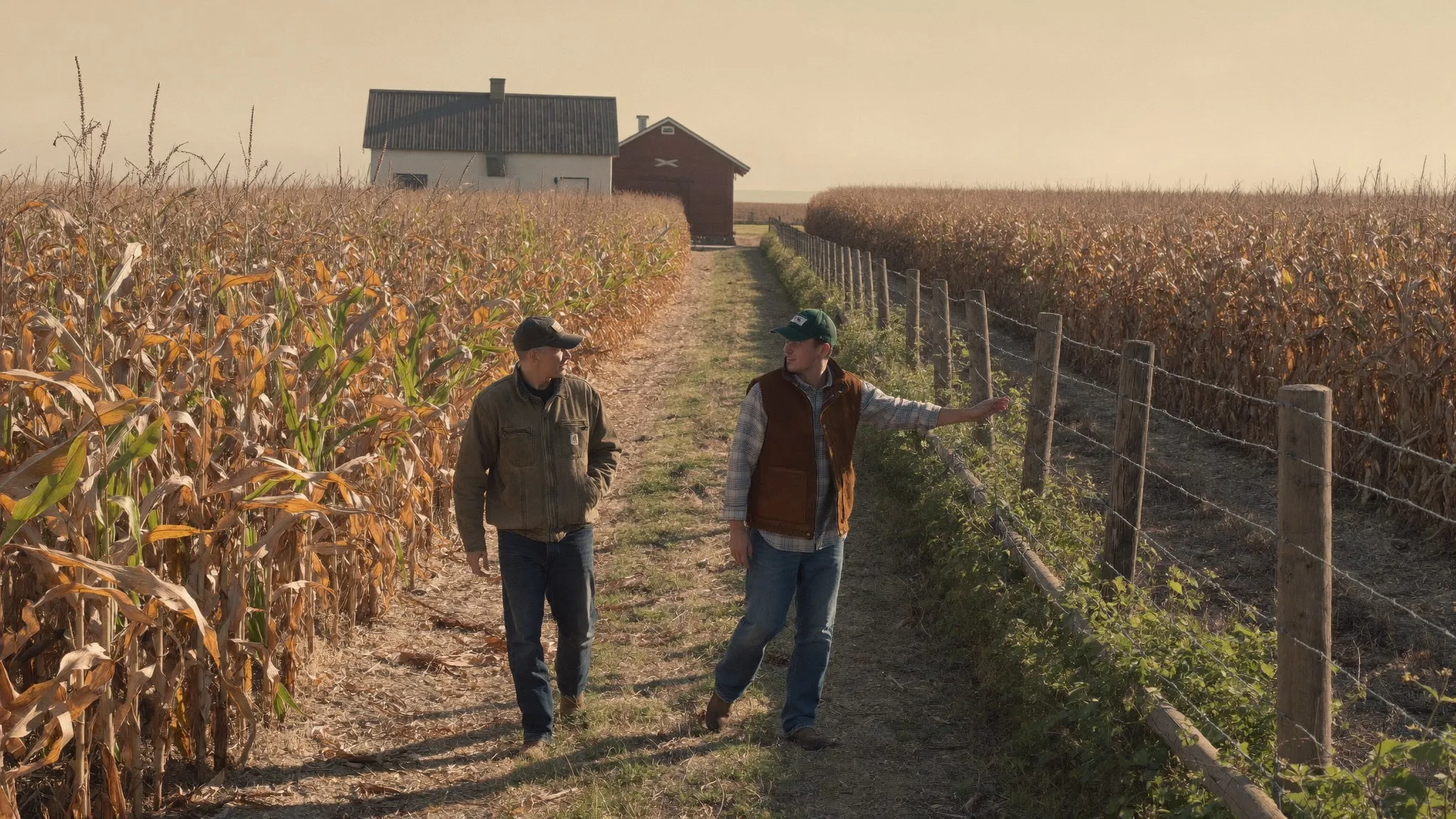
The cash-rent conversation between operators and landlords in spring 2026 is meaningfully different than it was three years ago, and the difference is mostly about margin. Cash corn in the $4.20 to $4.40 range against current input costs leaves a thinner per-acre return than 2022’s $6 corn did, and rent levels that were set during the boom years are taking longer to renegotiate downward than landlords would prefer or operators can sustain. For a meaningful share of producers facing renewal in 2026, the question that wasn’t on the table in 2022 is back: at what point does it make more sense to buy the parcel than to keep paying the rent?
The math is specific to each parcel and each operator, but the framework is consistent. Run the numbers honestly.
The current cash-rent landscape
Cash rents on top-productivity ground in the Corn Belt are running roughly as follows in spring 2026:
- High-productivity central Iowa: $260 to $310 per acre
- Average-productivity central Iowa: $215 to $260 per acre
- Eastern Illinois: $280 to $340 per acre
- South-central Nebraska, irrigated: $280 to $360 per acre
- South-central Nebraska, dryland: $130 to $185 per acre
The pressure point in 2026 is that breakeven cash rent — the rent level at which the operator earns a defensible return after inputs, equipment ownership, and a modest operator-management charge — is commonly running 15 to 25 percent below where contracted rents actually sit on the better ground. Operators are absorbing the spread to maintain operating scale, but the question of how long they can keep absorbing it is what’s driving the conversation.
The purchase math
For a parcel currently rented at $275 per acre, the purchase question runs through the following logic. Assume an 80-acre central Iowa tract at $14,000 per acre, total purchase price $1,120,000. The operator can put 30 percent down ($336,000) and finance the remaining $784,000.
At specialty farm credit terms — call it 7.25 percent on a 25-year amortization, with a 7-year rate-reset — the annual payment lands at roughly $68,000 per year ($850/acre). On the same 80 acres, the cash-rent obligation at $275 was $22,000 per year ($275/acre). The purchase looks worse on annual cash, by $46,000 per year.
But that comparison is incomplete in three ways:
Principal versus interest. The $68,000 annual payment includes principal reduction. In year one, roughly $51,000 of the payment is interest and $17,000 is principal — meaning the operator is paying $51,000 in true expense and effectively saving $17,000 into the equity of the parcel. That principal share grows every year of the amortization.
Tax treatment. Interest is deductible. The interest portion of the payment ($51,000 year one) generates a tax shield worth meaningful money against farm income — roughly $13,000 to $18,000 of federal-plus-state tax savings at typical farm marginal rates.
Land appreciation. Cash rent is pure expense. Purchase exposes the operator to whatever the parcel does in value over the holding period. If Iowa land holds at current levels, that’s neutral. If it appreciates 2 percent annually, that’s $22,400 per year of unrealized appreciation on the 80-acre parcel.
Run the actual numbers — with the right rate, amortization, and stress-test assumptions — through a monthly payment calculator for farm loans before treating the math as settled. The framework above is directionally correct; the specifics depend on the deal.
When the purchase math wins
Three conditions make the purchase case structurally stronger:
Operating tie-in. A parcel contiguous to existing owned ground, or one the operator has farmed for several years, carries lower transition risk and stronger underwriting from specialty lenders than a standalone first-time acquisition. Farmland purchase loans specifically structured for contiguous expansion commonly come with better terms than purchases of unrelated ground.
Estate and succession planning. For multi-generational operations planning for transition, owned land carries different planning options than rented ground. The purchase that pencils marginally on year-one cash flow may pencil meaningfully better when viewed as a 20-year hold against a succession plan.
Long-term inflation hedge. Operators with strong overall balance sheets who view farmland as a hold-forever asset class rather than as an operating cost line make the purchase decision against a different return horizon. The 7-percent rate is the financing cost; the actual return is the operating margin plus the long-term appreciation plus the inflation hedge over decades.
When cash rent wins
Three conditions where staying with the rented structure is the better answer:
Acquisition would deplete operating capital. If the down payment would leave the operation without the working-capital cushion to manage a soft year, the acquisition risk is meaningfully higher than the rent cost. Cash rent is expensive but it’s flexible.
The operator is in a growth phase elsewhere. If the producer is expanding equipment capacity, building grain storage, or otherwise deploying capital in directions that earn returns faster than land appreciation, the right capital allocation is probably not to convert operating capital into illiquid real estate.
The landlord relationship is sound. Cash-rent relationships with landlords who are reasonable about renewal terms and patient through soft years are genuinely valuable. The math may suggest purchase; the relationship may suggest staying with the rental and renegotiating terms instead.
The negotiation that often resolves both sides
For many parcels in 2026, the right answer isn’t either pure cash rent or outright purchase — it’s a renegotiated rent structure that better matches both sides’ risk tolerance. Three structures that have become more common in 2026 renewals:
Flex rent tied to price and yield. A base rent (below the previous straight cash level) plus a bonus tied to actual commodity price and harvested yield. This shares the risk and reward more fairly between operator and landlord.
Multi-year leases with built-in renegotiation triggers. A 3-year lease at a fixed rate with a rate-review provision tied to specific commodity price thresholds.
Right-of-first-refusal on sale. A rental structure that gives the operator first option to purchase if the landlord decides to sell — which protects the operator’s investment in soil improvements and rotation discipline without requiring immediate acquisition capital.
A network of lenders that underwrite farm cash flow and the legal infrastructure around farmland leasing are generally familiar with these structures and can support either side of the conversation.
The bottom line
The cash-rent versus purchase question is back on the table in 2026 because the rent math has tightened to a point where doing the same thing as last year isn’t necessarily the right answer. Purchase makes sense on parcels with operating tie-in, succession purpose, or long-term hold rationale — and where the operating capital allows it. Cash rent makes sense where flexibility, capital allocation elsewhere, or relationship considerations carry more weight. The framework that works is running the actual numbers against the actual parcel, not defaulting to whichever answer the operator chose last cycle.